
Unlike many historic European destinations defined by cobblestone streets and medieval facades, Rotterdam is a city born from reinvention. Extensively rebuilt after the devastation of World War II, the second-largest city in the Netherlands has transformed into a dynamic canvas of futuristic architecture, cutting-edge design, and a fiercely independent cultural scene. Today, global travelers flock to this thriving port city to experience an urban energy that is entirely unique within the Dutch landscape.
Whether you are arriving for a weekend getaway or stopping over during a larger European tour, navigating a city defined by continuous movement requires a seamless approach to logistics. Stepping off the train at the hyper-modern Rotterdam Centraal station immediately reveals the city’s fast-paced allure.
For visitors looking to explore the sweeping cultural districts or architectural highlights without being held back by heavy bags, secure Luggage Storage Rotterdam options provide an easy way to free up your hands immediately upon arrival. Utilizing dedicated services like Radical Storage allows you to drop off your suitcases at verified local businesses, ensuring you can dive straight into the neighborhood streets unencumbered.
The Masterpieces of Rotterdam Architecture
To truly understand Rotterdam, one must understand its relationship with spatial design. The city functions as a living museum for modern architecture, where bold experiments in form and function are woven directly into the daily lives of its residents.
The Cube Houses (Kubuswoningen)
Designed by visionary architect Piet Blom in the late 1970s and completed in 1984, the Cube Houses remain one of the most recognizable landmarks in the country. Blom tilted conventional, cube-shaped living spaces 45 degrees and perched them atop hexagonal pillars. The concept was intended to mimic a village within a city, where each house represents an stylized tree and the entire complex forms a forest.
Walking through the sharp angles and tilted walkways of this residential development challenges standard spatial perceptions. One of the homes, the Kijk-Kubus, operates as a museum museum, offering a fascinating glimpse into how residents manage furniture and daily life within walls slanted at precise 54.7-degree angles.
Markthal (The Market Hall)
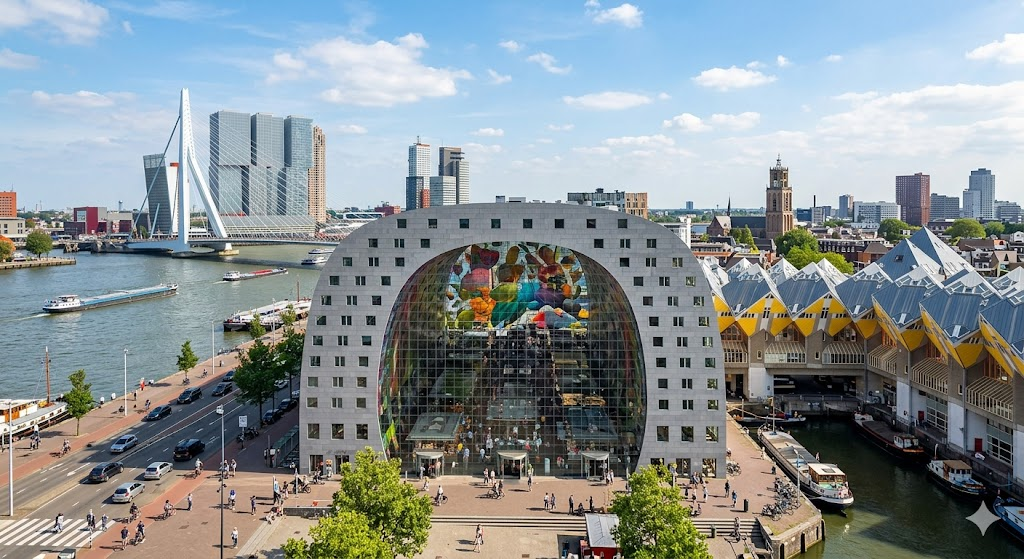
Located just a short walk from the Cube Houses in the historic Laurenskwartier district, the Markthal is a triumph of multi-use urban design. Conceived by the architectural firm MVRDV, this massive structure features a residential apartment building shaped like a giant, inverted horseshoe.
The interior arch of the building reveals a soaring marketplace covered in a vivid, 11,000-square-meter mural titled The Horn of Plenty. Created by artists Arno Coenen and Iris Roskam, this digital artwork depicts giant fruits, vegetables, flowers, and insects, earning the building its nickname: the “Sistine Chapel of Rotterdam.”
Below this vibrant canopy, over a hundred fresh food stalls, restaurants, and specialist shops offer everything from traditional Dutch stroopwafels to fresh herring and international delicacies.
The Erasmus Bridge (Erasmusbrug)
Connecting the northern and southern halves of the city across the Nieuwe Maas river, the Erasmus Bridge is an engineering masterpiece that defines the city’s skyline. Designed by Ben van Berkel, this 800-meter-long cable-stayed bridge features a striking, asymmetrical white pylon that rises 139 meters into the air.
Its graceful, angled silhouette has earned it the colloquial name “The Swan” (De Zwaan). Walking or cycling across the bridge provides panoramic views of the historic Scheepvaartkwartier (Shipping Quarter) on one side and the towering skyscrapers of the Kop van Zuid district on the other.
Neighborhood Exploration: Beyond the Concrete
While the grand architectural landmarks draw millions of visitors annually, the true soul of Rotterdam is found within its distinct and diverse neighborhoods. Each district offers a different perspective on how the city balances its industrious port identity with creative lifestyle trends.
Witte de Withstraat: The Cultural Heart
If you are looking for the center of Rotterdam’s nightlife, contemporary art, and culinary innovation, Witte de Withstraat is the place to be. This bustling avenue is lined with avant-garde art galleries, independent boutiques, vibrant street art murals, and some of the city’s finest eateries.
During the day, you can explore the contemporary exhibitions at the Melly Art Institute or browse local design shops. As night falls, the street transforms into a lively social hub filled with craft beer bars, outdoor terraces, and restaurants serving global street food.
Delfshaven: A Glimpse of the Past
To experience what Rotterdam looked like before the mid-stadium transformations of the 20th century, take a journey to the historic borough of Delfshaven. This picturesque inner-city marina miraculously survived the wartime bombardments and preserves a beautiful collection of 17th-century canal houses, traditional windmills, and historic shipyards.
Delfshaven holds deep historical significance as the departure point from which the Pilgrim Fathers sailed for America in 1620. Today, it is a peaceful enclave where you can stroll along quiet canals, visit the historic Pilgrim Fathers Church, or enjoy a locally brewed ale at the De Pelgrim brewery.
Kop van Zuid and Katendrecht
Often referred to as the “Manhattan on the Maas,” Kop van Zuid is built on old, abandoned port docks and now hosts towering skyscrapers designed by world-renowned architects like Rem Koolhaas and Renzo Piano. At the heart of this district sits the historic Hotel New York, the former headquarters of the Holland-America Line.
Just a short walk across the Rijnhaven Bridge brings you to Katendrecht, a former sailors’ quarter that has evolved into a premier culinary hotspot. The centerpiece of this neighborhood is the Fenix Food Factory, a revitalized port warehouse where local artisans produce fresh bread, craft beer, cheese, and roasted coffee, creating an authentic community-driven food experience.
Practical Tips for the Independent Traveler
Managing your logistics efficiently is key to getting the most out of your time in Rotterdam. The city is highly accessible, but knowing how to navigate its systems will enhance your overall travel experience.
Getting Around
Rotterdam possesses a world-class public transportation system operated by RET, consisting of comprehensive tram networks, clean metro lines, and zero-emission buses. The most flexible way to travel is by using a contactless debit/credit card or an OV-chipkaart to tap on and off across the network. For a unique vantage point, consider taking the fast-paced Waterbus or a vintage water taxi to zip between riverside destinations.
Luggage Management
Because Rotterdam is a city built for walking and cycling, dragging heavy suitcases along transit platforms or through crowded markets like the Markthal can severely limit your mobility. While train stations offer standard coin lockers, these can fill up quickly during peak seasons or event weekends. Utilizing a reliable network like Radical Storage gives you the freedom to book affordable space online at local convenience stores, hotels, or cafes scattered across major neighborhoods, ensuring your belongings are safe while you wander freely.
Alternative Digital Services
While optimizing your transit options, you may also encounter standard lockboxes or alternative platforms like Usebounce, Stasher, or LuggageHero. If you decide to evaluate multiple service options during your European journey, always check the operational hours of individual local partners beforehand to align smoothly with your train departures or check-in windows.
Art, Innovation, and Green Spaces
Rotterdam’s forward-thinking approach extends deeply into its cultural institutions and sustainability initiatives, making it a stellar destination for lifestyle enthusiasts and eco-conscious travelers alike.
Museumpark
For art lovers, Museumpark is an essential stop. This beautifully landscaped green zone acts as a gateway to several of the city’s most important cultural venues. Here, you will find the Kunsthal Rotterdam, a striking exhibition space designed by Rem Koolhaas that hosts rotating international exhibitions spanning fine art, photography, and fashion.
Right nearby is the Depot Boijmans Van Beuningen, the world’s first publicly accessible art storage facility. Covered in 6,603 square meters of reflective glass mirrors, the bowl-shaped building mirrors the surrounding park and skyline, while its rooftop forest offers sweeping views across the entire city.
The Historic Garden Schoonoord
Tucked away near the Euromast tower is Schoonoord, a beautifully preserved historic garden that serves as an oasis of absolute calm. Dating back to the 18th century, this hidden gem features serene ponds, ancient beech trees, and meticulously manicured lawns. It offers a stark, peaceful contrast to the towering skyscrapers and industrial energy found just a few blocks away, making it the perfect spot for a quiet afternoon break.
From its striking architectural achievements to its hidden historic corners, Rotterdam is a city that rewards curiosity and active exploration. By planning your logistics smartly, packing light, and keeping your hands free to capture the city’s endless creative angles, you can fully immerse yourself in the dynamic energy of this modern Dutch classic.
